
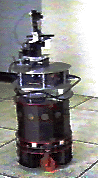
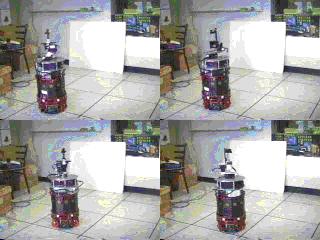
The mobile robotics and shape recognition group is an informal grouping of people and projects at the centre. The group has at least 6 mobile robots sporting a collection of sensors including sonar, video, BIRIS, and infra-red reflectance, depending on the current experiments in progress. The primary computing resources employ the Linux, IRIX and SUNOS operating systems, and a few other computing devices integrated into the general CIM computing environment.
Note that while most of the links in this page are local to your CD, a few point to outside sources and, as such, you will require internet access to view them.
This group is involved in issues of form representation and discovery. This relates specifically to the
Key technical foci are the abstraction of shape models across scale, the relationship between signals and symbolic descriptions. Projects that we are preoccupied with include: robot pose estimation (i.e. localization), place recognition, efficient exploration strategies, robot rendezvous, multi-robot collaboration, map representation, map merging and navigation.
A typical prosaic objective is to create a robot than can learn
your office layout over the weekend:

This is a shot of a few of us in the lab. From left to right: Robert Sim, Scott Burlington, Deeptiman Jugessur, Gregory Dudek, Ioannis Rekleitis, Francois Belair, Richard Unger, Sandra Polifroni, Eric Bourque, L. Abril Torres-Mendez, and Michel Taix (visiting from LAAS).
If you have the Quicktime VR plugin, here's a movie
of our group.
You can get more information several
current or recent research projects. Several of these project
descriptions have on-line publications accompanying them. Most
work here is carried out by graduate students, through faculty
collaboration, or in the context of undergraduate term projects,
as well as by occasional post-doctoral researchers. This includes
work on robot position estimation, navigation, exploration, and
multi-robot collaboration.
We have several tools available for use, including the McGill Mobile Robotics Architecture
(MMRA) development environment. This environment includes
Robodaemon, a mobile robot controller and simulator for a variety
of standard mobile robot platforms.
If you want to apply to be a grad student working in this group,
you can get further
information from the School of Computer Science. Note that
CIM is not an "academic unit" and different faculty
are officially associated with different departments.
A bibliography on mobile robotics, together with entries on
related research topics, can be searched
on-line (this is an external link).
You are invited to submit additional
entries to be included in the bibliography.
Note: this page is informally maintained at CIM by Professor
Gregory Dudek and Saul
Simhon from the School
of Computer Science and, as such, is not meant to be representative
of research at the Centre for Intelligent Machines (CIM) or McGill as a whole. The CD version
of this page was adapted by Robert
Sim.
Last update: December, 1998.