 |
| Home | People | Research | Publications | Studies | Links | Wiki | CIM |
Ongoing Research at MRL
Note: Further information about our Research can also be found on our older projects page, or in our publications.
Combining data from distributed range sensors (DRMS)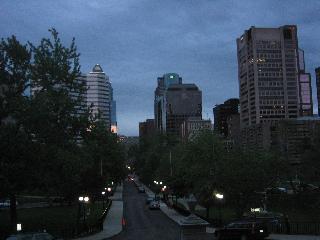
We are developing tools and techniques for inferring environment structure from a network of widely separated range sensors. DRMS web site |
Sensing for Underwater Robots (AQUA)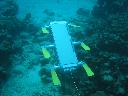
Project AQUA is a joint research project between Dalhousie University, York University, and McGill University involving the development of an autonomous underwater hexapod robot. Several McGill projects relate to AQUA including the design and development of the vehicle itself, the swimming mechanism, the vision-based localization methods and 3-D inference from underwater monocular images. |
Collaborative Filtering From Multiple Cues
We are currently working on a recommendation system which allows users to specify not only which items were enjoyed, and which were not, but also to specify which features were important to the decision. We believe that having knowledge of the reasoning behind preferences will allow the system to better predict future preferences. You can try the prototype system at http://www.recommendz.com or this alternative link to the recommender system for movies. |
Range Synthesis for Mobile Robot Environment Modeling
We are currently working on inferring complete range maps where only video images and very limited range data is available. We allow a mobile robot to rapidly collect a set of video images and very limited amount of range data from the environment and then infer the rest of the map it does not capture directly. Our goal is to facilitate the building of 3D environment models by exploiting the fact that both video imaging and limited range sensing are ubiquitous readily-available technologies while complete volume scanning is prohibitive on most mobile platforms. |
| Interest Operators Sandra Polifroni is currently doing research on interest operators and human preattentive vision. Her work uses both psychophysics and computer science to qualitatively evaluate the performance of interest operators relative human vision. |
PCA Background Invariance
Appearance based recognition using Principal Components Analysis with the added ability to account for varying backgrounds. This is done using an attention operator to focus on the object to be recognised and performing PCA only on the sub-windows within the object. |
| Real-time Recognition and Collision Avoidance Several members of the mobile robotics group are assembling components of our software infrastructure into a real-time mobile robotics testbed. |
Computational Geometry Problems in Mobile Robotics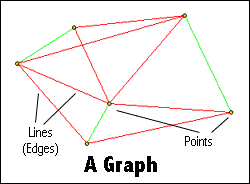
Several members of the mobile robotics group are assembling components of our software infrastructure into a real-time mobile robotics testbed. |
Distributed Robot Control Software Environment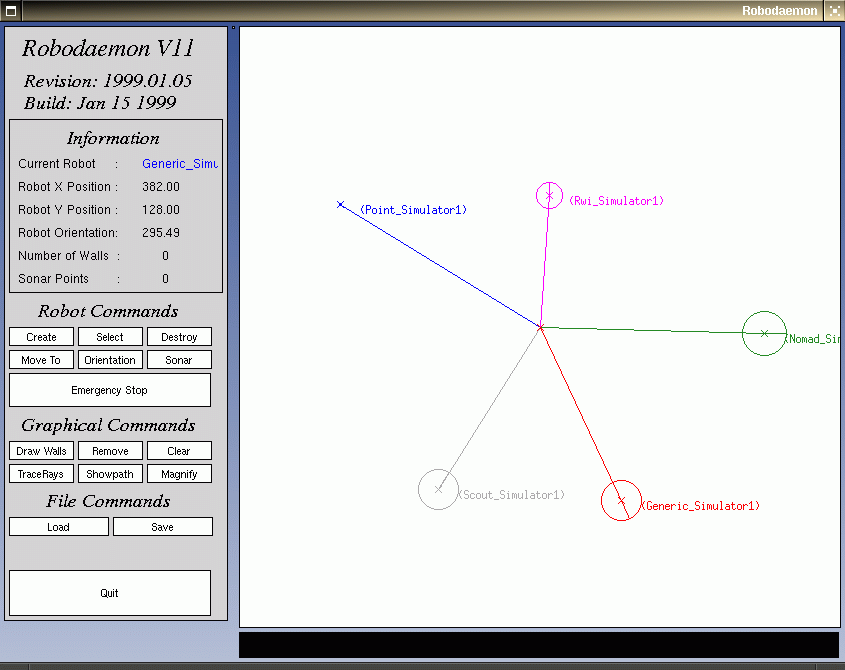
A Distributed, device independent mobile robot controller and simulator. It supports distributed computation and visualization and can control one or more real Nomad or RWI robots. A beta version and some additional details are available on the project page. |
Multi-Robot Exploration and Rendezvous
This project deals with the exploration of an unknown environment using two or more robots working together. Key aspects of the problems are coordination, and particularly rendezvous, between the robots, and efficient decomposition of the exploration task. |
Environment Shape and Layout from Active Shadows
This project deals with the inference of environmental structure from shadow information. |
| Object description and recognition This project involves shape modelling based on a combination of local curvature information at multiple scale, and global superquadric surface fitting. |
Mobile Robot Exploration by using Fused Data from Two Sensors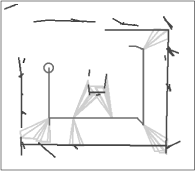
This research investigates the combined use of a sonar range finder and a laser range finder (QUADRIS or BIRIS) for exploring a structured indoor environment. The methodology is called "just-in-time" sensing. |
Virtual Environment Construction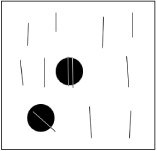
We are examining techniques for the creation and management of virtual reality analogues for the real world. This includes the automatic acquisition of image-based VR images, as well as the automated selection of viewpoints and scenes of interest. Further information on the image acquisition system is available by following the link. |
Localizing a Robot with Minimum Travel |
Accurate Position Estimation from Learned Visual Landmarks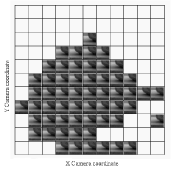
Methods for learning, encoding, detecting, and using visual landmarks for mobile robot pose estimation. |
Multi-Robot Collaboration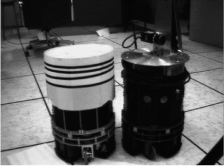
We are interested in elaborating a taxonomy for systems of multiple mobile robots. The specific issues we are foc using on are the relationships between inter-robot communication, sensing, and coordination of behaviour in the context of position estimation and exploration. |
| Mapping using weak information Autonomous navigation using sensory information often depends on a usable map of the environment. This work deals with the automatic creation of such a maps by an autonomous agent and the minimal requirements such a map must satisfy in order to be useful. One aspect of this work is the analysis of how uncertainty either in the map or in sensing devices relates to the reliability and cost of navigation and and path planning. Another aspect is the development of sensing strategies and behaviours that facilitate reliable self-location and map construction. |
Note: Further information about our Research can also be found on our older projects page, or in our publications.